The Transformers:
Combining Monadic Effects
"Any sufficiently complicated program contains an ad hoc, informally-specified, bug-ridden, slow implementation of half of a monad transformer."
– A functional programmer's lament (after Greenspun's Tenth Rule)
If you've ever written a utility method that takes a CompletableFuture<Either<E, A>> and tries to flatMap across both layers, you've already started building one. Transformers formalise the pattern.
- Why directly nesting monadic types like
CompletableFuture<Either<E, A>>leads to complex, unwieldy code - How monad transformers wrap nested monads to provide a unified interface with familiar
mapandflatMapoperations - The available transformers in Higher-Kinded-J: EitherT, MaybeT, OptionalT, ReaderT, and StateT
- How to choose the right transformer for your use case based on the effect you need to add
The Effect Path API provides a fluent, concrete wrapper around these transformers. For most use cases you can work entirely with Path types and never touch the raw transformer machinery. See Stack Archetypes for named patterns.
| Path Type | Corresponding Transformer |
|---|---|
EitherPath<E, A> | EitherT<F, E, A> |
MaybePath<A> | MaybeT<F, A> |
OptionalPath<A> | OptionalT<F, A> |
ReaderPath<R, A> | ReaderT<F, R, A> |
WithStatePath<S, A> | StateT<S, F, A> |
Use the raw transformer when you need to combine effects with a different outer monad (e.g. CompletableFuture, IO, or a custom monad).

The Problem: Monads Don't Compose
When building real applications, you rarely need just one effect. An operation might be asynchronous and also fail with domain errors. Another might require configuration and also be async. A third might need to track state while potentially returning nothing.
Each of these effects has a clean monadic representation in isolation. The trouble starts when you combine them.
What Nesting Looks Like in Practice
Consider a service that fetches a user asynchronously and might fail:
// The nested type: async + typed error
CompletableFuture<Either<DomainError, User>> fetchUser(String userId) { ... }
CompletableFuture<Either<DomainError, Order>> createOrder(User user) { ... }
CompletableFuture<Either<DomainError, Receipt>> processPayment(Order order) { ... }

// Composing them manually:
CompletableFuture<Either<DomainError, Receipt>> workflow =
    fetchUser("user-42").thenCompose(eitherUser ->
        eitherUser.fold(
            error -> CompletableFuture.completedFuture(Either.left(error)),
            user -> createOrder(user).thenCompose(eitherOrder ->
                eitherOrder.fold(
                    error -> CompletableFuture.completedFuture(Either.left(error)),
                    order -> processPayment(order)
                )
            )
        )
    );
Three steps. Already deeply nested. Every step requires the same boilerplate: check if the inner Either is Left, propagate the error, or unwrap the Right and continue. Add a fourth step and the indentation grows further. Add error recovery and it becomes genuinely difficult to read.
The problem is structural: CompletableFuture and Either each have their own flatMap, but Java gives you no way to unify them into a single sequencing operation.
The Solution: Transformer as Wrapper
A monad transformer T takes an outer monad F and produces a new monad T<F> that combines both effects. The transformer handles the interleaving of contexts automatically.
    ┌───────────────────────────────────────────────────────────────┐
    │  HOW A TRANSFORMER WORKS                                      │
    │                                                               │
    │                   ┌─────────────────────────┐                 │
    │                   │   Transformer (EitherT) │                 │
    │                   │                         │                 │
    │   flatMap ───────▶│  1. Sequence outer F    │──────▶ result   │
    │                   │  2. Check inner Either  │                 │
    │                   │  3. Route: Left → skip  │                 │
    │                   │          Right → apply  │                 │
    │                   └─────────────────────────┘                 │
    │                                                               │
    │   You call one flatMap. The transformer does both.            │
    └───────────────────────────────────────────────────────────────┘
The same workflow with EitherT:
EitherTMonad<CompletableFutureKind.Witness, DomainError> eitherTMonad =
    new EitherTMonad<>(CompletableFutureMonad.INSTANCE);

Kind<EitherTKind.Witness<CompletableFutureKind.Witness, DomainError>, Receipt> workflow =
    For.from(eitherTMonad, EitherT.fromKind(fetchUser("user-42")))
        .from(user -> EitherT.fromKind(createOrder(user)))
        .from(order -> EitherT.fromKind(processPayment(order)))
        .yield((user, order, receipt) -> receipt);
One flatMap sequences the async operation and propagates errors. No manual fold, no repeated Either.left wrapping, no growing indentation. The nesting is still there (it must be), but the transformer hides it.
Key Characteristics
- Stacking – Transformers allow "stacking" monadic effects in a standard way
- Unified Interface – The resulting transformed monad implements
Monad(and oftenMonadError), so you use the samemap,flatMap,ofyou already know - Abstraction – The complexity of managing the nested structure is encapsulated; you work with a single monadic layer
All transformers require an outer monad F where F extends WitnessArity<TypeArity.Unary>. This ensures the transformer can work with any properly-typed monad in the framework.
Transformers in Higher-Kinded-J
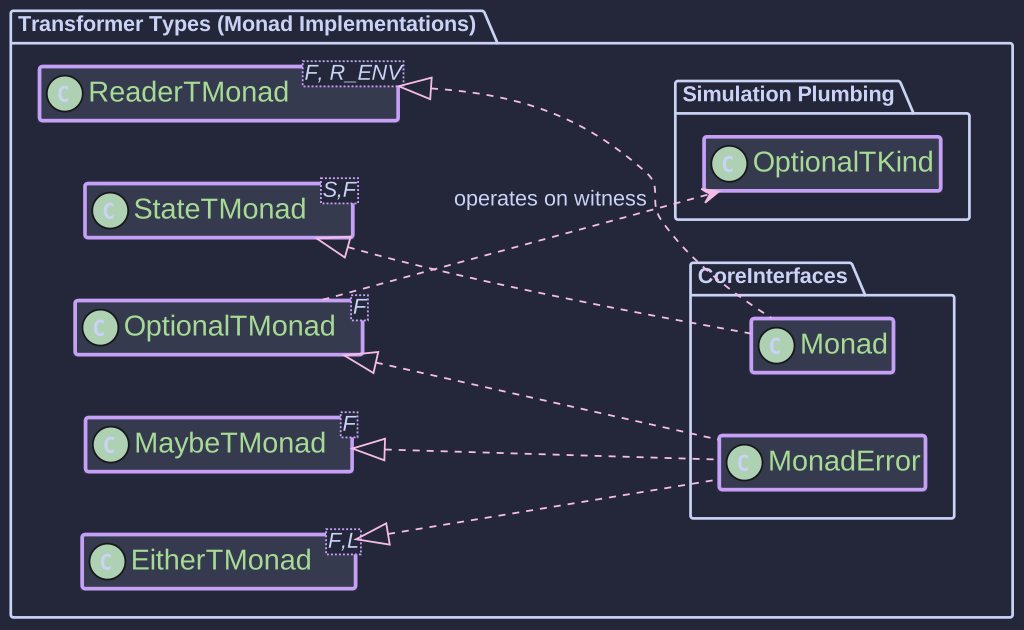
Higher-Kinded-J provides five transformers. Each solves a specific composition problem:
EitherT: Typed Errors in Any Context
The problem: Your async operation can fail with a domain-specific error, and you need to sequence multiple such operations without manual error propagation.
The solution: EitherT<F, E, A> wraps Kind<F, Either<E, A>> and provides MonadError<..., E>, giving you flatMap for sequencing, raiseError for failures, and handleErrorWith for recovery.
Usage: How to use the EitherT Monad Transformer
OptionalT: When Absence Meets Other Effects
The problem: Your async data retrieval might return nothing (user not found, config missing), and you need to chain lookups without checking each Optional manually.
The solution: OptionalT<F, A> wraps Kind<F, Optional<A>> and provides MonadError<..., Unit>, where Unit represents the "empty" state. Chain lookups with flatMap; if any step returns empty, the rest are skipped.
Usage: How to use the OptionalT Monad Transformer
MaybeT: Functional Optionality Across Monads
The problem: Same as OptionalT, but you're using Higher-Kinded-J's Maybe type rather than java.util.Optional.
The solution: MaybeT<F, A> wraps Kind<F, Maybe<A>> with the same MonadError<..., Unit> interface. Functionally equivalent to OptionalT; choose based on which optional type your codebase uses.
Usage: How to use the MaybeT Monad Transformer
ReaderT: Threading Configuration Through Effects
The problem: Multiple operations need access to shared configuration (database URLs, API keys, feature flags), and each is also wrapped in another effect like CompletableFuture. Passing the config manually through every function signature is tedious and error-prone.
The solution: ReaderT<F, R, A> wraps a function R -> Kind<F, A>. The environment R is provided once at the end, when you run the computation; all intermediate operations receive it implicitly through flatMap.
Usage: How to use the ReaderT Monad Transformer
StateT: Managing State Across Effect Boundaries
The problem: You need to thread mutable state through a sequence of operations that are also wrapped in another effect (e.g., a stack that can fail on pop, a counter that increments across async steps).
The solution: StateT<S, F, A> wraps a function S -> Kind<F, StateTuple<S, A>>. Each flatMap threads the updated state to the next operation; the outer monad's effects are handled simultaneously.
Usage: How to use the StateT Monad Transformer
Transformer Patterns at a Glance
| Pattern | Transformer | Outer Monad | What You Get |
|---|---|---|---|
| Async + Error | EitherT | CompletableFuture | Async workflows with typed error propagation |
| Async + Absence | OptionalT / MaybeT | CompletableFuture | Async lookups that may return nothing |
| Config + Async | ReaderT | CompletableFuture | Dependency injection for async services |
| Config + Error | ReaderT | Either | Environment-dependent computations that can fail |
| State + Failure | StateT | Optional / Either | Stateful operations that can short-circuit |
| State + Async | StateT | CompletableFuture | State threading across async boundaries |
- Forgetting to unwrap: The result of a transformer computation is still wrapped. Call
.value()on the transformer to extract the underlyingKind<F, Either<E, A>>(or equivalent) when you need to interact with the outer monad directly. - Wrong monad order:
EitherT<Future, E, A>(error inside future) is different from hypotheticalFutureT<Either, E, A>(future inside error). The outer monad is the one the transformer wraps around; the inner effect is what the transformer adds. Choose based on which semantics you need. - Overusing transformers: If you only combine effects in one or two places, manual nesting may be simpler. Transformers shine when the pattern is repeated across many operations.
Previous: Stack Archetypes Next: EitherT