The StateT Transformer:
Managing State Across Effect Boundaries
- How to add stateful computation to any existing monad
- Building stack operations that can fail (StateT with Optional)
- Understanding the relationship between State and StateT<S, Identity, A>
- Creating complex workflows that manage both state and other effects
- Using
get,set,modifyoperations within transformer contexts
The Problem: Stateful Operations that Can Fail
Imagine a stack data structure where pop might fail on an empty stack. Without StateT, you end up managing both the state transitions and the optionality by hand:
// Without StateT: manual state + optional management
Optional<StateTuple<List<Integer>, Integer>> pop(List<Integer> stack) {
    if (stack.isEmpty()) return Optional.empty();
    List<Integer> newStack = new LinkedList<>(stack);
    Integer value = newStack.remove(0);
    return Optional.of(StateTuple.of(newStack, value));
}

// Composing: push, push, pop, pop, sum the popped values
Optional<StateTuple<List<Integer>, Integer>> workflow(List<Integer> initial) {
    var afterPush1 = push(initial, 10);   // Returns StateTuple (always succeeds)
    var afterPush2 = push(afterPush1.state(), 20);
    var pop1Result = pop(afterPush2.state());
    if (pop1Result.isEmpty()) return Optional.empty();
    var pop2Result = pop(pop1Result.get().state());
    if (pop2Result.isEmpty()) return Optional.empty();
    int sum = pop1Result.get().value() + pop2Result.get().value();
    return Optional.of(StateTuple.of(pop2Result.get().state(), sum));
}
Each operation returns both a new state and a value; the optionality adds another layer of checking. The state threading is manual and error-prone. Miss one .get().state() call and you use stale state.
The Solution: StateT
// With StateT: state threading + optionality handled automatically
var computation =
    For.from(ST_OPT_MONAD, push(10))
        .from(_ -> push(20))
        .from(_ -> pop())
        .from(_ -> pop())
        .yield((a, b, p1, p2) -> {
            System.out.println("Popped: " + p1 + ", " + p2);
            return p1 + p2;
        });

Optional<StateTuple<List<Integer>, Integer>> result =
    OPTIONAL.narrow(StateTKindHelper.runStateT(computation, Collections.emptyList()));
// → Optional.of(StateTuple([], 30))
The state flows from one operation to the next through flatMap. If any operation returns Optional.empty() (e.g., popping an empty stack), the rest are skipped. No manual state passing, no null checks.
How StateT Works
StateT<S, F, A> represents a computation that takes an initial state S, produces a result A and a new state S, all within the context of a monad F.
    ┌──────────────────────────────────────────────────────────┐
    │  StateT<List<Integer>, OptionalKind.Witness, A>          │
    │                                                          │
    │    State S ─────▶ ┌────────────────────────┐             │
    │    (initial)      │  Function:             │             │
    │                   │  S → Kind<F, (S, A)>   │             │
    │                   └────────────┬───────────┘             │
    │                                │                         │
    │                                ▼                         │
    │                   ┌─── Optional ──────────┐              │
    │                   │                       │              │
    │                   │  empty()  │  of(S, A) │              │
    │                   │           │           │              │
    │                   └───────────────────────┘              │
    │                                                          │
    │  flatMap ──▶ threads updated state to next operation     │
    │  map ──────▶ transforms value, state unchanged           │
    │  runStateT ──▶ provides initial state, returns F<(S,A)>  │
    │  evalStateT ──▶ returns F<A> (discards final state)      │
    │  execStateT ──▶ returns F<S> (discards value)            │
    └──────────────────────────────────────────────────────────┘
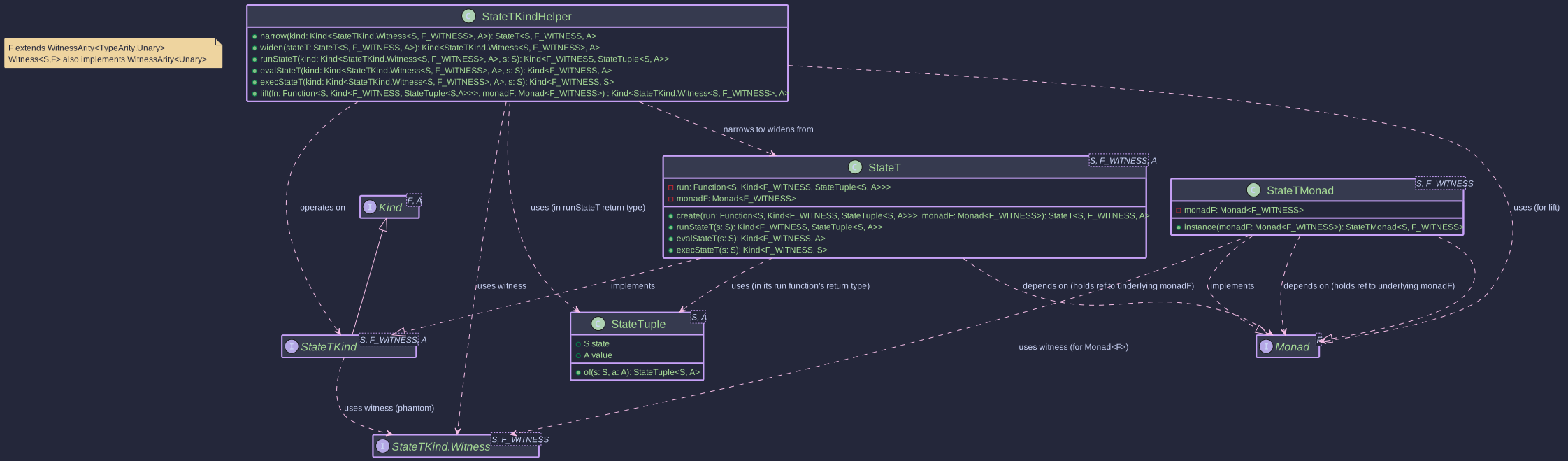
S: The type of the state.F: The witness type for the underlying monad (e.g.,OptionalKind.Witness,IOKind.Witness).A: The type of the computed value.StateTuple<S, A>: A container holding the pair(state, value).
The fundamental structure is a function: S -> F<StateTuple<S, A>>
// StateT holds: Function<S, Kind<F, StateTuple<S, A>>>
StateT<Integer, OptionalKind.Witness, String> computation =
    StateT.create(
        currentState -> {
            if (currentState < 0) return OPTIONAL.widen(Optional.empty());
            return OPTIONAL.widen(Optional.of(
                StateTuple.of(currentState + 1, "Value: " + currentState)));
        },
        optionalMonad);
Setting Up StateTMonad
The StateTMonad<S, F> class implements Monad<StateTKind.Witness<S, F>>. It requires a Monad<F> instance for the underlying monad:
OptionalMonad optionalMonad = OptionalMonad.INSTANCE;

StateTMonad<Integer, OptionalKind.Witness> stateTMonad =
    StateTMonad.instance(optionalMonad);
StateT<S, F, A>: The primary data type holdingS -> Kind<F, StateTuple<S, A>>.StateTKind<S, F, A>: TheKindrepresentation for generic monadic usage.StateTKind.Witness<S, F>: The higher-kinded type witness. BothSandFare part of the witness.StateTMonad<S, F>: TheMonadinstance, providingof,map,flatMap,ap.StateTKindHelper: Utility fornarrow,runStateT,evalStateT,execStateT.StateTuple<S, A>: A record holding(S state, A value).
Running StateT Computations
// Run: returns F<StateTuple<S, A>>
Kind<OptionalKind.Witness, StateTuple<Integer, String>> result =
    StateTKindHelper.runStateT(computation, 10);
// → Optional.of(StateTuple(11, "Value: 10"))

// Eval: returns F<A> (discards state)
Kind<OptionalKind.Witness, String> valueOnly =
    StateTKindHelper.evalStateT(computation, 10);
// → Optional.of("Value: 10")

// Exec: returns F<S> (discards value)
Kind<OptionalKind.Witness, Integer> stateOnly =
    StateTKindHelper.execStateT(computation, 10);
// → Optional.of(11)
Composing StateT Actions
Like any monad, StateT computations compose with map and flatMap:
Kind<StateTKind.Witness<Integer, OptionalKind.Witness>, Integer> initial =
    StateT.create(s -> OPTIONAL.widen(
        Optional.of(StateTuple.of(s + 1, s * 2))), optionalMonad);

Kind<StateTKind.Witness<Integer, OptionalKind.Witness>, String> mapped =
    stateTMonad.map(val -> "Computed: " + val, initial);

// Run with state 5:
// 1. initial: state=6, value=10
// 2. map: value → "Computed: 10"
// Result: Optional.of(StateTuple(6, "Computed: 10"))
Kind<StateTKind.Witness<Integer, OptionalKind.Witness>, Integer> firstStep =
    StateT.create(s -> OPTIONAL.widen(
        Optional.of(StateTuple.of(s + 1, s * 10))), optionalMonad);

Function<Integer, Kind<StateTKind.Witness<Integer, OptionalKind.Witness>, String>>
    secondStepFn = prevValue -> StateT.create(
        s -> {
            if (prevValue > 100) {
                return OPTIONAL.widen(Optional.of(
                    StateTuple.of(s + prevValue, "Large: " + prevValue)));
            }
            return OPTIONAL.widen(Optional.empty()); // Fail if too small
        }, optionalMonad);

Kind<StateTKind.Witness<Integer, OptionalKind.Witness>, String> combined =
    stateTMonad.flatMap(secondStepFn, firstStep);

// Run with state 15: firstStep → (16, 150), secondStep(150) → (166, "Large: 150")
// Run with state 5:  firstStep → (6, 50), secondStep(50) → empty (too small)
State-Specific Operations
Common state operations can be constructed using StateT.create:
// get: retrieve the current state as the value
static <S, F> Kind<StateTKind.Witness<S, F>, S> get(Monad<F> monadF) {
    return StateT.create(s -> monadF.of(StateTuple.of(s, s)), monadF);
}

// set: replace the state, return Unit
static <S, F> Kind<StateTKind.Witness<S, F>, Unit> set(S newState, Monad<F> monadF) {
    return StateT.create(s -> monadF.of(StateTuple.of(newState, Unit.INSTANCE)), monadF);
}

// modify: update the state with a function, return Unit
static <S, F> Kind<StateTKind.Witness<S, F>, Unit> modify(
        Function<S, S> f, Monad<F> monadF) {
    return StateT.create(s -> monadF.of(StateTuple.of(f.apply(s), Unit.INSTANCE)), monadF);
}

// gets: extract a value derived from the state
static <S, F, A> Kind<StateTKind.Witness<S, F>, A> gets(
        Function<S, A> f, Monad<F> monadF) {
    return StateT.create(s -> monadF.of(StateTuple.of(s, f.apply(s))), monadF);
}
Real-World Example: Stack with Failure
The problem: You need stack push/pop operations where popping an empty stack produces an absence rather than an exception, and you want to compose these operations cleanly.
The solution:
private static final OptionalMonad OPT_MONAD = OptionalMonad.INSTANCE;
private static final StateTMonad<List<Integer>, OptionalKind.Witness> ST_OPT_MONAD =
    StateTMonad.instance(OPT_MONAD);

static Kind<StateTKind.Witness<List<Integer>, OptionalKind.Witness>, Unit>
    push(Integer value) {
  return StateTKindHelper.stateT(stack -> {
      List<Integer> newStack = new LinkedList<>(stack);
      newStack.add(0, value);
      return OPTIONAL.widen(Optional.of(StateTuple.of(newStack, Unit.INSTANCE)));
  }, OPT_MONAD);
}

static Kind<StateTKind.Witness<List<Integer>, OptionalKind.Witness>, Integer> pop() {
  return StateTKindHelper.stateT(stack -> {
      if (stack.isEmpty()) {
          return OPTIONAL.widen(Optional.empty()); // Cannot pop empty stack
      }
      List<Integer> newStack = new LinkedList<>(stack);
      Integer popped = newStack.remove(0);
      return OPTIONAL.widen(Optional.of(StateTuple.of(newStack, popped)));
  }, OPT_MONAD);
}

// Compose with For comprehension:
var computation =
    For.from(ST_OPT_MONAD, push(10))
        .from(_ -> push(20))
        .from(_ -> pop())
        .from(_ -> pop())
        .yield((a, b, p1, p2) -> {
            System.out.println("Popped in order: " + p1 + ", then " + p2);
            return p1 + p2;
        });

List<Integer> initialStack = Collections.emptyList();
Optional<StateTuple<List<Integer>, Integer>> result =
    OPTIONAL.narrow(StateTKindHelper.runStateT(computation, initialStack));
// → Optional.of(StateTuple([], 30))

// Popping an empty stack:
Optional<StateTuple<List<Integer>, Integer>> emptyPop =
    OPTIONAL.narrow(StateTKindHelper.runStateT(pop(), Collections.emptyList()));
// → Optional.empty()
Why this works: The For comprehension sequences state operations through flatMap. Each push returns the updated stack as new state; each pop either returns the popped value with an updated stack, or Optional.empty() which short-circuits the rest. The state threading is completely automatic.
Relationship to State Monad
The State Monad (State<S, A>) is a specialised case of StateT. Specifically, State<S, A> is equivalent to StateT<S, IdKind.Witness, A>, where Id is the Identity monad (a monad that adds no effects).
If your stateful computation doesn't need to combine with another effect, use State<S, A> directly. Reach for StateT when you need state and another effect (optionality, error handling, async).
- Using stale state: In manual state threading, it's easy to accidentally use the state from step 1 in step 3.
StateT.flatMapeliminates this by threading updated state automatically. - Null in
ap: Theapmethod requires the function it extracts from the firstStateTcomputation to be non-null. Anullfunction will cause aNullPointerException. - Confusing StateT with ReaderT: If your "state" never changes, you probably want
ReaderT. UseStateTonly when operations need to modify the state.
- State Monad - Understand the basics of stateful computations
- Monad Transformers - General concept of monad transformers
- ReaderT - When you need read-only environment, not mutable state
- Draughts Example ("checkers") - See the HKJ State Monad used in a game
Previous: ReaderT