The ReaderT Transformer:
Threading Configuration Through Effects
"No man is an island, entire of itself."
– John Donne, Meditation XVII
No computation is independent of its environment. ReaderT makes that dependency explicit and composable.
- How to combine dependency injection (Reader) with other effects like async operations
- Building configuration-dependent workflows that are also async or failable
- Using
ask,reader, andliftto work with environment-dependent computations - Creating testable microservice clients with injected configuration
- Managing database connections, API keys, and other contextual dependencies
The Problem: Configuration Everywhere
Consider a service that needs API keys and URLs for every operation:
// Without ReaderT: passing config through every function
CompletableFuture<ServiceData> fetchData(AppConfig config, String itemId) {
    return CompletableFuture.supplyAsync(() ->
        callApi(config.apiKey(), config.serviceUrl(), itemId));
}

CompletableFuture<ProcessedData> processData(AppConfig config, ServiceData data) {
    return CompletableFuture.supplyAsync(() ->
        transform(data, config.apiKey()));
}

// Every call requires explicit config passing:
CompletableFuture<ProcessedData> workflow(AppConfig config) {
    return fetchData(config, "item123")
        .thenCompose(data -> processData(config, data));
}
The config parameter threads through every function signature, every call site, every test. It's noise that obscures the actual logic. Rename a config field, and you touch every function in the chain.
The Solution: ReaderT
// With ReaderT: config is implicit
ReaderT<CompletableFutureKind.Witness, AppConfig, ServiceData>
    fetchDataRT(String itemId) {
  return ReaderT.of(config ->
      FUTURE.widen(CompletableFuture.supplyAsync(() ->
          callApi(config.apiKey(), config.serviceUrl(), itemId))));
}

ReaderT<CompletableFutureKind.Witness, AppConfig, ProcessedData>
    processDataRT(ServiceData data) {
  return ReaderT.reader(futureMonad,
      config -> transform(data, config.apiKey()));
}

// Config provided once, at the end:
Kind<CompletableFutureKind.Witness, ProcessedData> result =
    composedWorkflow.run().apply(prodConfig);
The AppConfig is threaded implicitly through flatMap. Each operation declares its dependency on AppConfig in its return type, but never receives it as a parameter. The config is provided once, when you run the computation.
    ┌──────────────────────────────────────────────────────────┐
    │  ReaderT<CompletableFutureKind.Witness, AppConfig, A>    │
    │                                                          │
    │        ┌── AppConfig ──┐                                 │
    │        │               │                                 │
    │        │  apiKey       │                                 │
    │        │  serviceUrl   │                                 │
    │        │  executor     │                                 │
    │        └───────┬───────┘                                 │
    │                │                                         │
    │                ▼                                         │
    │   ┌─── Function: R → Kind<F, A> ───────────────────┐     │
    │   │                                                │     │
    │   │  config → CompletableFuture<result>            │     │
    │   │                                                │     │
    │   └────────────────────────────────────────────────┘     │
    │                                                          │
    │  flatMap ──▶ threads same config to next operation       │
    │  map ──────▶ transforms result, config unchanged         │
    │  ask ──────▶ gives you the config itself                 │
    │  run ──────▶ provides config, returns F<A>               │
    └──────────────────────────────────────────────────────────┘
How ReaderT Works
ReaderT<F, R, A> wraps a function R -> Kind<F, A>. When you supply an environment of type R, you get back a monadic value Kind<F, A>.
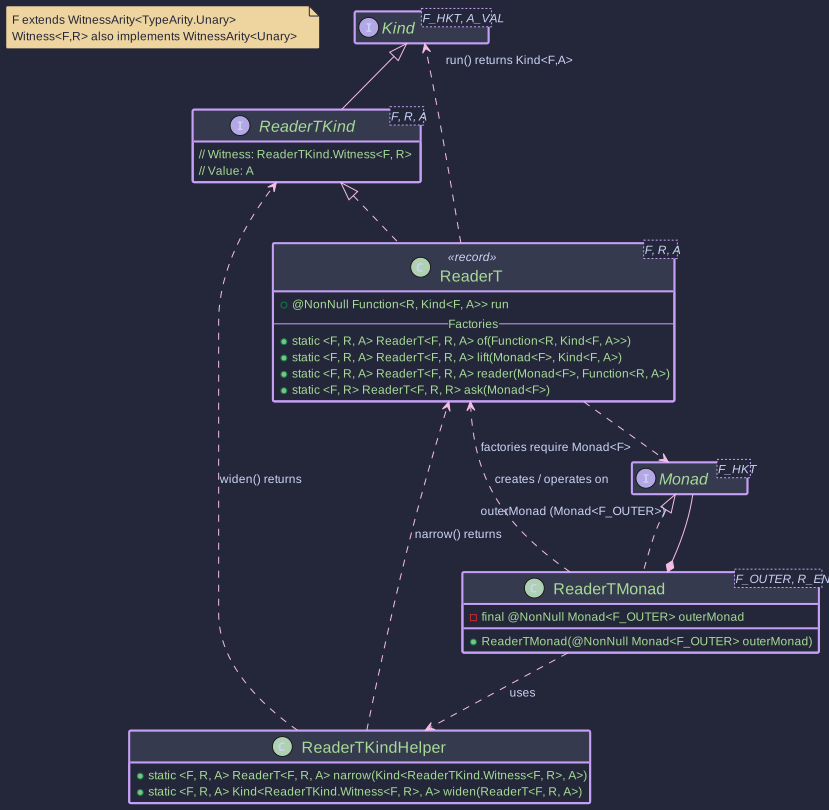
F: The witness type of the outer monad (e.g.,CompletableFutureKind.Witness).R: The type of the read-only environment (configuration, dependencies).A: The type of the value produced, within the outer monadF.run: The core functionR -> Kind<F, A>.
public record ReaderT<F, R, A>(@NonNull Function<R, Kind<F, A>> run)
    implements ReaderTKind<F, R, A> {
  // ... static factory methods ...
}
Setting Up ReaderTMonad
The ReaderTMonad<F, R> class implements Monad<ReaderTKind.Witness<F, R>>, providing standard monadic operations. It requires a Monad<F> instance for the outer monad:
OptionalMonad optionalMonad = OptionalMonad.INSTANCE;
record AppConfig(String apiKey) {}

ReaderTMonad<OptionalKind.Witness, AppConfig> readerTOptionalMonad =
    new ReaderTMonad<>(optionalMonad);
Witness Type: ReaderTKind<F, R, A> extends Kind<ReaderTKind.Witness<F, R>, A>. The outer monad F and environment R are fixed; A is the variable value type.
KindHelper: ReaderTKindHelper provides READER_T.widen and READER_T.narrow for safe conversion.
Kind<ReaderTKind.Witness<F, R>, A> kind = READER_T.widen(readerT);
ReaderT<F, R, A> concrete = READER_T.narrow(kind);
Key Operations
readerTMonad.of(value): Lifts a pure value intoReaderT. The environment is ignored. Result:ReaderT(r -> outerMonad.of(value)).readerTMonad.map(func, readerTKind): Transforms the result valueA -> Bwithin the outer monad. The environment passes through unchanged. Result:ReaderT(r -> F<B>).readerTMonad.flatMap(func, readerTKind): The core sequencing operation. Runs the firstReaderTwith the environment to getKind<F, A>. If it yields anA, appliesfuncto get a newReaderT<F, R, B>, which is then also run with the same environment. This is what makes configuration threading automatic.
Creating ReaderT Instances
OptionalMonad optMonad = OptionalMonad.INSTANCE;
record Config(String setting) {}
Config testConfig = new Config("TestValue");

// 1. Directly from R -> F<A> function
ReaderT<OptionalKind.Witness, Config, String> rt1 = ReaderT.of(
    cfg -> OPTIONAL.widen(Optional.of("Data based on " + cfg.setting())));
// Run: OPTIONAL.narrow(rt1.run().apply(testConfig))
// → Optional.of("Data based on TestValue")

// 2. Lifting an existing F<A> (environment ignored)
Kind<OptionalKind.Witness, Integer> optionalValue =
    OPTIONAL.widen(Optional.of(123));
ReaderT<OptionalKind.Witness, Config, Integer> rt2 =
    ReaderT.lift(optMonad, optionalValue);
// Run: always returns Optional.of(123) regardless of config

// 3. From R -> A function (result lifted into F)
ReaderT<OptionalKind.Witness, Config, String> rt3 =
    ReaderT.reader(optMonad, cfg -> "Hello from " + cfg.setting());
// Run: Optional.of("Hello from TestValue")

// 4. ask: provides the environment itself as the result
ReaderT<OptionalKind.Witness, Config, Config> rt4 = ReaderT.ask(optMonad);
// Run: Optional.of(Config("TestValue"))
Real-World Example: Configuration-Dependent Async Services
The problem: You have async service operations that all need an AppConfig (API keys, URLs, executor). You want to compose them without passing config through every call.
The solution:
static final Monad<CompletableFutureKind.Witness> futureMonad =
    CompletableFutureMonad.INSTANCE;
static final ReaderTMonad<CompletableFutureKind.Witness, AppConfig> cfReaderTMonad =
    new ReaderTMonad<>(futureMonad);

record AppConfig(String apiKey, String serviceUrl, ExecutorService executor) {}
record ServiceData(String rawData) {}
record ProcessedData(String info) {}

// Operation 1: fetch data (needs config for URL and API key)
static ReaderT<CompletableFutureKind.Witness, AppConfig, ServiceData>
    fetchServiceDataRT(String itemId) {
  return ReaderT.of(config -> FUTURE.widen(
      CompletableFuture.supplyAsync(() ->
          new ServiceData("Raw data for " + itemId + " from " + config.serviceUrl()),
          config.executor())));
}

// Operation 2: process data (needs config for API key)
static ReaderT<CompletableFutureKind.Witness, AppConfig, ProcessedData>
    processDataRT(ServiceData data) {
  return ReaderT.reader(futureMonad,
      config -> new ProcessedData("Processed: " + data.rawData().toUpperCase()));
}

// Compose: fetch then process
Kind<ReaderTKind.Witness<CompletableFutureKind.Witness, AppConfig>, ProcessedData>
    workflowRT = cfReaderTMonad.flatMap(
        data -> READER_T.widen(processDataRT(data)),
        READER_T.widen(fetchServiceDataRT("item123")));

ReaderT<CompletableFutureKind.Witness, AppConfig, ProcessedData> composedWorkflow =
    READER_T.narrow(workflowRT);

// Run with different configs:
AppConfig prodConfig = new AppConfig("prod_key", "https://api.prod.example.com", executor);
AppConfig stagingConfig = new AppConfig("staging_key", "https://api.staging.example.com", executor);

ProcessedData prodResult = FUTURE.join(composedWorkflow.run().apply(prodConfig));
ProcessedData stagingResult = FUTURE.join(composedWorkflow.run().apply(stagingConfig));
Why this works: The AppConfig is threaded through both fetchServiceDataRT and processDataRT by flatMap. The same workflow runs against production and staging simply by providing different configs at the run().apply(...) call. The workflow definition is completely decoupled from the environment.
Using ask to Access Configuration Mid-Workflow
The problem: Within a composed workflow, you need to read a specific config value without restructuring the computation.
The solution:
ReaderT<CompletableFutureKind.Witness, AppConfig, AppConfig> getConfigRT =
    ReaderT.ask(futureMonad);

Kind<ReaderTKind.Witness<CompletableFutureKind.Witness, AppConfig>, String>
    getServiceUrlRT = cfReaderTMonad.map(
        (AppConfig cfg) -> "Service URL: " + cfg.serviceUrl(),
        READER_T.widen(getConfigRT));

String stagingUrl = FUTURE.join(
    READER_T.narrow(getServiceUrlRT).run().apply(stagingConfig));
// → "Service URL: https://api.staging.example.com"
ReaderT.ask returns the entire environment as the result, which you can then map over to extract specific fields.
Fire-and-Forget Operations with Unit
The problem: Some operations (logging, initialisation, sending metrics) depend on configuration but don't produce a meaningful return value.
The solution: Use Unit as the value type:
static ReaderT<CompletableFutureKind.Witness, AppConfig, Unit> initialiseComponentRT() {
    return ReaderT.of(config -> FUTURE.widen(
        CompletableFuture.runAsync(() -> {
            System.out.println("Initialising with API Key: " + config.apiKey());
            // ... initialisation work ...
        }, config.executor()).thenApply(v -> Unit.INSTANCE)));
}

// Run:
Unit result = FUTURE.join(initialiseComponentRT().run().apply(prodConfig));
// → () (Unit.INSTANCE, signifying successful completion)
- Forgetting to run: A
ReaderTis a description of a computation, not the computation itself. It does nothing until you call.run().apply(config). If your tests pass but nothing happens, check that you are running theReaderT. - Mutating the environment:
Rshould be immutable.ReaderTpasses the sameRto every operation in a chain. Mutating it would break referential transparency and produce unpredictable results. - Using ReaderT when you need state changes: If the configuration changes between steps, you need
StateT, notReaderT. The "Reader" inReaderTmeans read-only.
- Monad Transformers - General concept and choosing the right transformer
- StateT - When your environment needs to change between steps
- EitherT - When operations can fail with typed errors
- Reader Monad for Dependency Injection - Practical examples without frameworks (12 min read)
- Functional Dependency Injection - Conference talk on Reader pattern (40 min watch)
- ReaderT Design Pattern - Michael Snoyman's production patterns (30 min read)
- A Fresh Perspective on Monads - Rock the JVM on composing monadic effects (20 min read)