Supported Types
- The complete catalogue of 29 supported types with HKT simulation, grouped by purpose
- Which typeclass instances (Functor, Monad, Traverse, etc.) each type provides
- How to choose the right type for your use case
- The unified pattern that every type follows: Kind interface, Witness type, Helper class
Choosing a Type
Not sure which type you need? Start here:
What does your computation do?
  |
  +-- Might be absent or fail?
  |     +-- Absent (no error info)       --> Maybe / Optional
  |     +-- Fail with typed error         --> Either
  |     +-- Fail with exception           --> Try
  |     +-- Collect ALL errors at once    --> Validated
  |     +-- Just a plain value            --> Id
  |
  +-- Has a side effect?
  |     +-- Deferred I/O                  --> IO
  |     +-- Async / concurrent            --> CompletableFuture / VTask
  |     +-- Reads shared config           --> Reader / Context
  |     +-- Threads mutable state         --> State
  |     +-- Accumulates a log             --> Writer
  |     +-- Expensive, compute-once       --> Lazy
  |
  +-- Produces multiple values?
  |     +-- Finite, in-memory             --> List
  |     +-- Lazy / potentially infinite   --> Stream / VStream
  |
  +-- Needs stack-safe recursion?         --> Trampoline
  +-- Building a DSL / interpreter?       --> Free / FreeAp
  +-- Combining two monadic effects?      --> MaybeT / EitherT / OptionalT / ReaderT / StateT
All Supported Types at a Glance
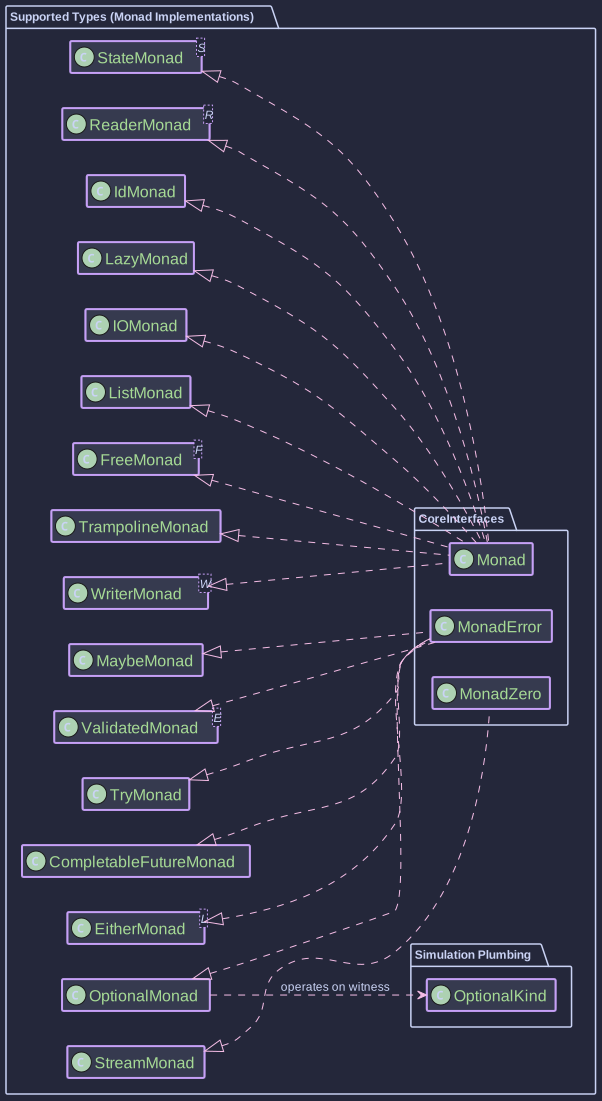
The diagram below shows every type grouped by category, with its highest typeclass instance annotated. The typeclass hierarchy is: Functor ← Applicative ← Monad ← MonadError, so a type tagged <<Monad>> also provides Functor and Applicative. Additional capabilities like Selective, Traverse, Bifunctor, and Alternative are shown where available.
The Unified Pattern
Every type follows the same HKT simulation structure:
| Piece | Purpose |
|---|---|
XxxKind<A> | HKT marker interface extending Kind<XxxKind.Witness, A> |
XxxKind.Witness | Phantom type that uniquely identifies the type constructor |
XxxKindHelper | Bridge utilities: widen() (concrete to Kind), narrow() (Kind to concrete) |
| Type class instances | Functor, Applicative, Monad, etc. parameterised by the Witness type |
Library-defined types (Maybe, Either, IO, etc.) directly implement their Kind interface, so widen/narrow are zero-cost casts. External Java types (Optional, List, Stream, CompletableFuture) use an internal holder record.
Type Details by Category
Value & Error Types
Six ways to model "this computation might not produce a value."
Id<A>: The "do nothing" wrapper. No effects, no surprises. Sounds pointless, but it is the neutral element that makes monad transformers and generic code work. When you need a Monad<F> but have no effect to model, Id is your answer.
Maybe<A>: Just(value) or Nothing. The library's own optional type with full typeclass support: Selective, Traverse, Alternative. Pick this over Optional when you want richer composition and don't need JDK API interop.
Optional<A>: HKT bridge to java.util.Optional. Same semantics as Maybe, but wraps the JDK type directly. Use this when your codebase already passes Optional values around and you want to lift them into generic HKT code without conversion.
Either<L, R>: Right(value) or Left(error). Right-biased. Unlike Maybe/Optional which only say "absent", Either carries a typed error L that explains why the computation failed. Also provides Bifunctor for mapping both sides.
Try<A>: Success(value) or Failure(throwable). Either specialised for exceptions. Wrap risky code with Try.tryOf(() -> ...) and it catches the exception for you. Reach for this when your error is always a Throwable.
Validated<E, A>: Valid(value) or Invalid(error). Looks like Either, but its killer feature is error accumulation: use applicative ap with a Semigroup<E> to collect ALL errors from independent validations, not just the first one. The go-to for form validation and input checking.
EitherOrBoth<L, R>: Left(error), Right(value), or Both(warnings, value). The inclusive-or (Ior/These): unlike Either/Validated, it models a success that also carries non-fatal warnings. Right-biased with total accessors; flatMap short-circuits on Left and accumulates a Both's warnings via a Semigroup. Reach for it when a result can be both a value and a list of problems.
Effect & Computation Types
Eight ways to model "this computation does something beyond returning a value."
IO<A>: Describes a side effect without running it. Nothing happens until you call unsafeRunSync(). File reads, API calls, database writes: anything that touches the outside world belongs in IO. Think of it as a recipe for a side effect.
Lazy<A>: Describes a pure computation without running it. Like IO, nothing happens until you call force(), but unlike IO, the result is memoised. Second call returns the cached value instantly. Perfect for expensive computations you may never need.
CompletableFuture<A>: HKT bridge to java.util.concurrent.CompletableFuture. Asynchronous computation that is already running. Provides MonadError so you can flatMap over futures and handle failures through the typeclass hierarchy.
VTask<A>: Lightweight task on virtual threads (JDK 21+). Like CompletableFuture but designed for structured concurrency: VTaskScope manages lifecycles, cancellation, and resource cleanup. The modern choice for concurrent Java.
Reader<R, A>: A function R -> A wrapped in a monad. Pass a shared environment (config, database pool, feature flags) to an entire computation graph without threading it through every parameter list. Dependency injection, functional style.
Context<R, A>: Like Reader, but built on JDK 21+ ScopedValue. Use when your environment is scoped to a thread or task rather than passed explicitly. Integrates with virtual-thread structured concurrency.
State<S, A>: A function S -> (S, A). Threads mutable state through a computation without actual mutation. Each step receives the current state and returns a new state alongside its result. Stateful algorithms, purely.
Writer<W, A>: Pairs every result with an accumulated log. Each flatMap step produces a log entry; the Monoid<W> combines them automatically. Extract the final value with run(), the complete log with exec(), or both with runWriter(). Audit trails, calculation receipts, metrics.
Collection Types
Three ways to model "this computation produces multiple values."
List<A>: HKT bridge to java.util.List. As a monad, flatMap models non-deterministic computation: map over each element, concatenate the results. Supports Selective, Traverse, and Alternative for rich collection operations in generic code.
Stream<A>: HKT bridge to java.util.stream.Stream. Lazy and potentially infinite, but single-use: consuming a stream exhausts it. Use for large or generated sequences where you don't want everything in memory at once.
VStream<A>: Virtual-thread reactive stream (JDK 21+). Backpressure, parallel operations, structured concurrency. Think of it as a modern, concurrent alternative to Stream for data pipelines that need to fan out across virtual threads.
Recursion & DSL Types
Four abstractions for when standard monads aren't enough.
Trampoline<A>: Turns recursive algorithms into stack-safe iterative ones. Instead of making a recursive call (which grows the stack), you return a data structure describing the call. A flat loop processes it. Handles 1,000,000+ iterations where naive recursion dies at 5,000.
Free<F, A>: Turns any instruction set into a monad. Build your program as a data structure, then interpret it however you like: real execution, testing, logging, optimisation. One program, many interpreters. The foundation for embedded DSLs.
FreeAp<F, A>: Like Free, but for independent operations. Because steps don't depend on each other, an interpreter can batch them, run them in parallel, or analyse all operations upfront before executing any.
Coyoneda<F, A>: Gives any type constructor a Functor instance for free, via the Yoneda lemma. Also enables map fusion: consecutive .map(f).map(g).map(h) calls collapse into a single .map(f.andThen(g).andThen(h)) at interpretation time.
Structural Types
Three building blocks for generic programming, optics, and categorical abstractions.
Const<C, A>: Holds a constant value C while A is a phantom type that exists only in the signature. Sounds abstract, but it powers lens getters and fold operations across the optics library. Provides Applicative when C has a Monoid.
Tuple2<A, B>: A simple pair with Bifunctor support. bimap transforms both elements; first and second transform one side. Used internally by State, Writer, and various optics operations.
Function<A, B>: HKT wrapper around java.util.function.Function with Profunctor support. dimap transforms both input and output; lmap pre-processes the input; rmap post-processes the output. The theoretical backbone of optic composition.
Monad Transformers
Five transformers that layer one monad's effects on top of another. "I need IO and Either" becomes EitherT<IOKind.Witness, MyError, A>.
MaybeT<F, A>: Adds presence/absence to any monad F. The inner computation is Kind<F, Maybe<A>>. Use when your IO or CompletableFuture might legitimately produce "no result."
EitherT<F, L, R>: Adds typed errors to any monad F. The inner computation is Kind<F, Either<L, R>>. The workhorse transformer: IO + error handling, CompletableFuture + typed failures, etc.
OptionalT<F, A>: Like MaybeT but wraps java.util.Optional. Use when your stack already uses Optional and you want JDK interop without conversion.
ReaderT<F, R, A>: Adds environment reading to any monad F. The inner computation is R -> Kind<F, A>. Thread configuration through an effectful computation without parameter pollution.
StateT<S, F, A>: Adds state threading to any monad F. The inner computation is S -> Kind<F, (S, A)>. Stateful algorithms that also need IO, error handling, or other effects.
Practise with concrete types in Tutorial 06: Concrete Types (7 exercises).
Next: CompletableFuture