The MaybeMonad:
Handling Optional Values with Non-Null Guarantee
- How Maybe provides null-safe optional values with guaranteed non-null contents
- The difference between Maybe and Optional (non-null guarantee in Just)
- Using Maybe as a MonadError with Unit as the error type
- Chaining operations with automatic Nothing propagation
- Building robust pipelines that handle absence gracefully
Purpose
How do you handle optional values in Java without falling into the null pointer trap? The Maybe<T> type in Higher-Kinded-J provides an elegant solution: representing a value that might be present (Just<T>) or absent (Nothing<T>), with one crucial guarantee: a Just<T> will never hold null.
The Maybe<T> type is conceptually similar to java.util.Optional<T> but with a key distinction: a Just<T> is guaranteed to hold a non-null value. This strictness helps prevent NullPointerExceptions when a value is asserted to be present. Maybe.fromNullable(T value) or MaybeMonad.of(T value) should be used if the input value could be null, as these will correctly produce a Nothing in such cases.
The MaybeMonad provides a monadic interface for Maybe, allowing for functional composition and integration with the Higher-Kinded Type (HKT) system. This facilitates chaining operations that may or may not yield a value, propagating the Nothing state automatically.
- Explicit Optionality with Non-Null Safety:
Just<T>guarantees its contained value is not null.Nothing<T>clearly indicates absence. - Functional Composition: Enables elegant chaining of operations using
map,flatMap, andap, whereNothingshort-circuits computations. - HKT Integration:
MaybeKind<A>(the HKT wrapper forMaybe<A>) andMaybeMonadallowMaybeto be used with generic functions and type classes that expectKind<F, A>whereF extends WitnessArity<?>, along with type classes likeFunctor<F>,Applicative<F>,Monad<M>, orMonadError<M, E>whereF extends WitnessArity<TypeArity.Unary>. - Error Handling for Absence:
MaybeMonadimplementsMonadError<MaybeKind.Witness, Unit>.Nothingis treated as the "error" state, withUnitas the phantom error type, signifying absence.
It implements MonadError<MaybeKind.Witness, Unit>, which transitively includes Monad<MaybeKind.Witness>, Applicative<MaybeKind.Witness>, and Functor<MaybeKind.Witness>.
Structure
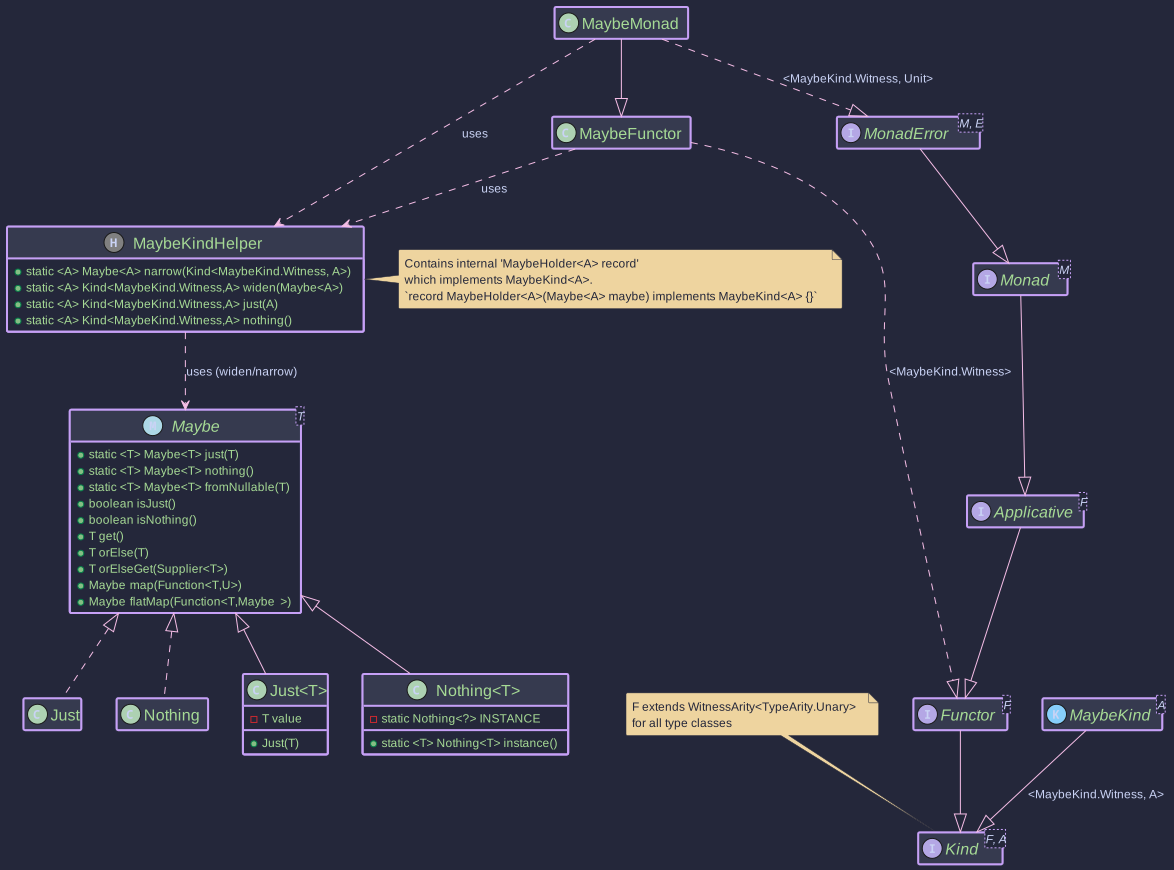
How to Use MaybeMonad and Maybe
Creating Instances
Maybe<A> instances can be created directly using static factory methods on Maybe, or via MaybeMonad for HKT integration. Since Just<T> and Nothing<T> directly implement MaybeKind<T>, they are first-class participants in the HKT simulation with zero runtime overhead for widen/narrow operations.
Direct Maybe Creation:
Creates a Just holding a non-null value. Throws NullPointerException if value is null.
Maybe<String> justHello = Maybe.just("Hello"); // Just("Hello")
Maybe<String> illegalJust = Maybe.just(null); // Throws NullPointerException
Returns a singleton Nothing instance.
Maybe<Integer> noInt = Maybe.nothing(); // Nothing
Creates Just(value) if value is non-null, otherwise Nothing.
Maybe<String> fromPresent = Maybe.fromNullable("Present"); // Just("Present")
Maybe<String> fromNull = Maybe.fromNullable(null);     // Nothing
MaybeKindHelper (for HKT wrapping):
MaybeKindHelper.widen(Maybe maybe)
Converts a Maybe<A> to Kind<MaybeKind.Witness, A>. Since Just and Nothing directly implement MaybeKind, this performs a null check and type-safe cast (zero overhead, no wrapper object allocation).
Kind<MaybeKind.Witness, String> kindJust = MAYBE.widen(Maybe.just("Wrapped"));
Kind<MaybeKind.Witness,Integer> kindNothing = MAYBE.widen(Maybe.nothing());
MaybeMonad Instance Methods:
Lifts a value into Kind<MaybeKind.Witness, A>. Uses Maybe.fromNullable() internally.
MaybeMonad maybeMonad = MaybeMonad.INSTANCE;
Kind<MaybeKind.Witness, String> kindFromMonad = maybeMonad.of("Monadic"); // Just("Monadic")
Kind<MaybeKind.Witness, String> kindNullFromMonad = maybeMonad.of(null);   // Nothing
Creates a Kind<MaybeKind.Witness, E> representing Nothing. The error (Unit) argument is ignored.
Kind<MaybeKind.Witness, Double> errorKind = maybeMonad.raiseError(Unit.INSTANCE); // Nothing
To get the underlying Maybe<A> from a MaybeKind<A>, use MAYBE.narrow():
MaybeKind<String> kindJust = MAYBE.just("Example");
Maybe<String> unwrappedMaybe = MAYBE.narrow(kindJust); // Just("Example")
System.out.println("Unwrapped: " + unwrappedMaybe);

MaybeKind<Integer> kindNothing = MAYBE.nothing();
Maybe<Integer> unwrappedNothing = MAYBE.narrow(kindNothing); // Nothing
System.out.println("Unwrapped Nothing: " + unwrappedNothing);
Interacting with Maybe values
The Maybe interface itself provides useful methods:
isJust(): Returnstrueif it's aJust.isNothing(): Returnstrueif it's aNothing.get(): Returns the value ifJust, otherwise throwsNoSuchElementException. Use with caution.orElse(@NonNull T other): Returns the value ifJust, otherwise returnsother.orElseGet(@NonNull Supplier<? extends @NonNull T> other): Returns the value ifJust, otherwise invokesother.get().toEither(L leftValue): Converts toEither<L, T>.Just(t)becomesRight(t),NothingbecomesLeft(leftValue).toEither(Supplier<L> leftSupplier): Lazy variant that only evaluates the supplier forNothing.- The
Maybeinterface also has its ownmapandflatMapmethods, which are similar in behaviour to those onMaybeMonadbut operate directly onMaybeinstances.
The toEither methods bridge between Maybe and Either, useful when you need to provide error context for absent values:
Maybe<User> maybeUser = findUser(userId);

// Convert with a static error value
Either<String, User> result = maybeUser.toEither("User not found");

// Convert with a lazy error (only computed if Nothing)
Either<UserError, User> result2 = maybeUser.toEither(
    () -> new UserError("User " + userId + " not found")
);

// Just(user) -> Right(user)
// Nothing    -> Left("User not found")
Key Operations (via MaybeMonad)
Applies f to the value inside ma if it's Just. If ma is Nothing, or if f returns null (which Maybe.fromNullable then converts to Nothing), the result is Nothing.
void mapExample() {
  MaybeMonad maybeMonad = MaybeMonad.INSTANCE;
  Kind<MaybeKind.Witness, Integer> justNum = MAYBE.just(10);
  Kind<MaybeKind.Witness, Integer> nothingNum = MAYBE.nothing();

  Function<Integer, String> numToString = n -> "Val: " + n;
  Kind<MaybeKind.Witness, String> justStr = maybeMonad.map(numToString, justNum); // Just("Val: 10")
  Kind<MaybeKind.Witness, String> nothingStr = maybeMonad.map(numToString, nothingNum); // Nothing

  Function<Integer, String> numToNull = n -> null;
  Kind<MaybeKind.Witness, String> mappedToNull = maybeMonad.map(numToNull, justNum); // Nothing

  System.out.println("Map (Just): " + MAYBE.narrow(justStr));
  System.out.println("Map (Nothing): " + MAYBE.narrow(nothingStr));
  System.out.println("Map (To Null): " + MAYBE.narrow(mappedToNull));
}
If ma is Just(a), applies f to a. f must return a Kind<MaybeKind.Witness, B>. If ma is Nothing, or f returns Nothing, the result is Nothing.
void flatMapExample() {
  MaybeMonad maybeMonad = MaybeMonad.INSTANCE;
  Function<String, Kind<MaybeKind.Witness, Integer>> parseString = s -> {
    try {
      return MAYBE.just(Integer.parseInt(s));
    } catch (NumberFormatException e) {
      return MAYBE.nothing();
    }
  };

  Kind<MaybeKind.Witness, String> justFiveStr = MAYBE.just("5");
  Kind<MaybeKind.Witness, Integer> parsedJust = maybeMonad.flatMap(parseString, justFiveStr); // Just(5)

  Kind<MaybeKind.Witness, String> justNonNumStr = MAYBE.just("abc");
  Kind<MaybeKind.Witness, Integer> parsedNonNum = maybeMonad.flatMap(parseString, justNonNumStr); // Nothing

  System.out.println("FlatMap (Just): " + MAYBE.narrow(parsedJust));
  System.out.println("FlatMap (NonNum): " + MAYBE.narrow(parsedNonNum));
}
If ff is Just(f) and fa is Just(a), applies f to a. Otherwise, Nothing.
void apExample() {
  MaybeMonad maybeMonad = MaybeMonad.INSTANCE;
  Kind<MaybeKind.Witness, Integer> justNum = MAYBE.just(10);
  Kind<MaybeKind.Witness, Integer> nothingNum = MAYBE.nothing();
  Kind<MaybeKind.Witness, Function<Integer, String>> justFunc = MAYBE.just(i -> "Result: " + i);
  Kind<MaybeKind.Witness, Function<Integer, String>> nothingFunc = MAYBE.nothing();

  Kind<MaybeKind.Witness, String> apApplied = maybeMonad.ap(justFunc, justNum); // Just("Result: 10")
  Kind<MaybeKind.Witness, String> apNothingFunc = maybeMonad.ap(nothingFunc, justNum); // Nothing
  Kind<MaybeKind.Witness, String> apNothingVal = maybeMonad.ap(justFunc, nothingNum); // Nothing

  System.out.println("Ap (Applied): " + MAYBE.narrow(apApplied));
  System.out.println("Ap (Nothing Func): " + MAYBE.narrow(apNothingFunc));
  System.out.println("Ap (Nothing Val): " + MAYBE.narrow(apNothingVal));
}
Example: handleErrorWith(Kind<MaybeKind.Witness, A> ma, Function<Void, Kind<MaybeKind.Witness, A>> handler)
If ma is Just, it's returned. If ma is Nothing (the "error" state), handler is invoked (with Unit.INSTANCE for Unit) to provide a recovery MaybeKind.
void handleErrorWithExample() {
  MaybeMonad maybeMonad = MaybeMonad.INSTANCE;
  Function<Unit, Kind<MaybeKind.Witness, String>> recover = v -> MAYBE.just("Recovered");

  Kind<MaybeKind.Witness, String> handledJust = maybeMonad.handleErrorWith(MAYBE.just("Original"), recover); // Just("Original")
  Kind<MaybeKind.Witness, String> handledNothing = maybeMonad.handleErrorWith(MAYBE.nothing(), recover);    // Just("Recovered")

  System.out.println("HandleError (Just): " + MAYBE.narrow(handledJust));
  System.out.println("HandleError (Nothing): " + MAYBE.narrow(handledNothing));
}
A complete example demonstrating generic usage:
public void monadExample() {
  MaybeMonad maybeMonad = MaybeMonad.INSTANCE;

  // 1. Create MaybeKind instances
  Kind<MaybeKind.Witness, Integer> presentIntKind = MAYBE.just(100);
  Kind<MaybeKind.Witness, Integer> absentIntKind = MAYBE.nothing();
  Kind<MaybeKind.Witness, String> nullInputStringKind = maybeMonad.of(null); // Becomes Nothing

  // 2. Use map
  Function<Integer, String> intToStatus = n -> "Status: " + n;
  Kind<MaybeKind.Witness, String> mappedPresent = maybeMonad.map(intToStatus, presentIntKind);
  Kind<MaybeKind.Witness, String> mappedAbsent = maybeMonad.map(intToStatus, absentIntKind);

  System.out.println("Mapped (Present): " + MAYBE.narrow(mappedPresent)); // Just(Status: 100)
  System.out.println("Mapped (Absent): " + MAYBE.narrow(mappedAbsent));   // Nothing

  // 3. Use flatMap
  Function<Integer, Kind<MaybeKind.Witness, String>> intToPositiveStatusKind = n ->
      (n > 0) ? maybeMonad.of("Positive: " + n) : MAYBE.nothing();

  Kind<MaybeKind.Witness, String> flatMappedPresent = maybeMonad.flatMap(intToPositiveStatusKind, presentIntKind);
  Kind<MaybeKind.Witness, String> flatMappedZero = maybeMonad.flatMap(intToPositiveStatusKind, maybeMonad.of(0)); // 0 is not > 0

  System.out.println("FlatMapped (Present Positive): " + MAYBE.narrow(flatMappedPresent)); // Just(Positive: 100)
  System.out.println("FlatMapped (Zero): " + MAYBE.narrow(flatMappedZero)); // Nothing

  // 4. Use 'of' and 'raiseError'
  Kind<MaybeKind.Witness, String> fromOf = maybeMonad.of("Direct Value");
  Kind<MaybeKind.Witness, String> fromRaiseError = maybeMonad.raiseError(Unit.INSTANCE); // Creates Nothing
  System.out.println("From 'of': " + MAYBE.narrow(fromOf)); // Just(Direct Value)
  System.out.println("From 'raiseError': " + MAYBE.narrow(fromRaiseError)); // Nothing
  System.out.println("From 'of(null)': " + MAYBE.narrow(nullInputStringKind)); // Nothing


  // 5. Use handleErrorWith
  Function<Void, Kind<MaybeKind.Witness, Integer>> recoverWithDefault =
      v -> maybeMonad.of(-1); // Default value if absent

  Kind<MaybeKind.Witness, Integer> recoveredFromAbsent =
      maybeMonad.handleErrorWith(absentIntKind, recoverWithDefault);
  Kind<MaybeKind.Witness, Integer> notRecoveredFromPresent =
      maybeMonad.handleErrorWith(presentIntKind, recoverWithDefault);

  System.out.println("Recovered (from Absent): " + MAYBE.narrow(recoveredFromAbsent)); // Just(-1)
  System.out.println("Recovered (from Present): " + MAYBE.narrow(notRecoveredFromPresent)); // Just(100)

  // Using the generic processData function
  Kind<MaybeKind.Witness, String> processedPresent = processData(presentIntKind, x -> "Processed: " + x, "N/A", maybeMonad);
  Kind<MaybeKind.Witness, String> processedAbsent = processData(absentIntKind, x -> "Processed: " + x, "N/A", maybeMonad);

  System.out.println("Generic Process (Present): " + MAYBE.narrow(processedPresent)); // Just(Processed: 100)
  System.out.println("Generic Process (Absent): " + MAYBE.narrow(processedAbsent));   // Just(N/A)

  // Unwrap to get back the standard Maybe
  Maybe<String> finalMappedMaybe = MAYBE.narrow(mappedPresent);
  System.out.println("Final unwrapped mapped maybe: " + finalMappedMaybe); // Just(Status: 100)
}

public static <A, B> Kind<MaybeKind.Witness, B> processData(
    Kind<MaybeKind.Witness, A> inputKind,
    Function<A, B> mapper,
    B defaultValueOnAbsence,
    MaybeMonad monad
) {
  // inputKind is now Kind<MaybeKind.Witness, A>, which is compatible with monad.map
  Kind<MaybeKind.Witness, B> mappedKind = monad.map(mapper, inputKind);

  // The result of monad.map is Kind<MaybeKind.Witness, B>.
  // The handler (Unit v) -> monad.of(defaultValueOnAbsence) also produces Kind<MaybeKind.Witness, B>.
  return monad.handleErrorWith(mappedKind, (Unit v) -> monad.of(defaultValueOnAbsence));
}
This example highlights how MaybeMonad facilitates working with optional values in a functional, type-safe manner, especially when dealing with the HKT abstractions and requiring non-null guarantees for present values.
For most use cases, prefer MaybePath which wraps Maybe and provides:
- Fluent composition with
map,via,recover - Seamless integration with the Focus DSL for structural navigation
- A consistent API shared across all effect types
// Instead of manual Maybe chaining:
Maybe<User> user = findUser(id);
Maybe<String> name = user.flatMap(u -> Maybe.fromNullable(u.name()));

// Use MaybePath for cleaner composition:
MaybePath<String> name = Path.maybe(findUser(id))
    .via(u -> Path.maybe(u.name()));
See Effect Path Overview for the complete guide.